Traveling to Canada With a Dog
🟢 Last Updated: May 2026
Traveling to Canada with a dog is straightforward for most personal pet trips. You still need to understand the entry rules, your dog’s rabies status, and the airline or border-crossing requirements before you go.
Canada’s process depends on your dog’s age, country of origin, purpose of the trip, and whether you are entering by land or air.
This guide gives you the full Canada dog travel overview first and then points you to the detailed guides.
Also includes Beckham and my experiences from our numerous trips to Canada over the years.
Canada Dog Travel QUICK Start

Requirement
Quick Answer
Difficulty
Easy for personal pet dogs
Health certificate
Not required for personal pet dogs older than 8 months traveling with their owner
Rabies vaccine
Required for all dogs 3 months or older
Titer test
Not required for most personal dogs
Parasite treatment
Not required for standard dog entry
Microchip
Not required but strongly recommended
Import permit
Not required for personal pet dogs
Quarantine
Not required if your dog meets the entry rules
Start here: Canada dog travel guides
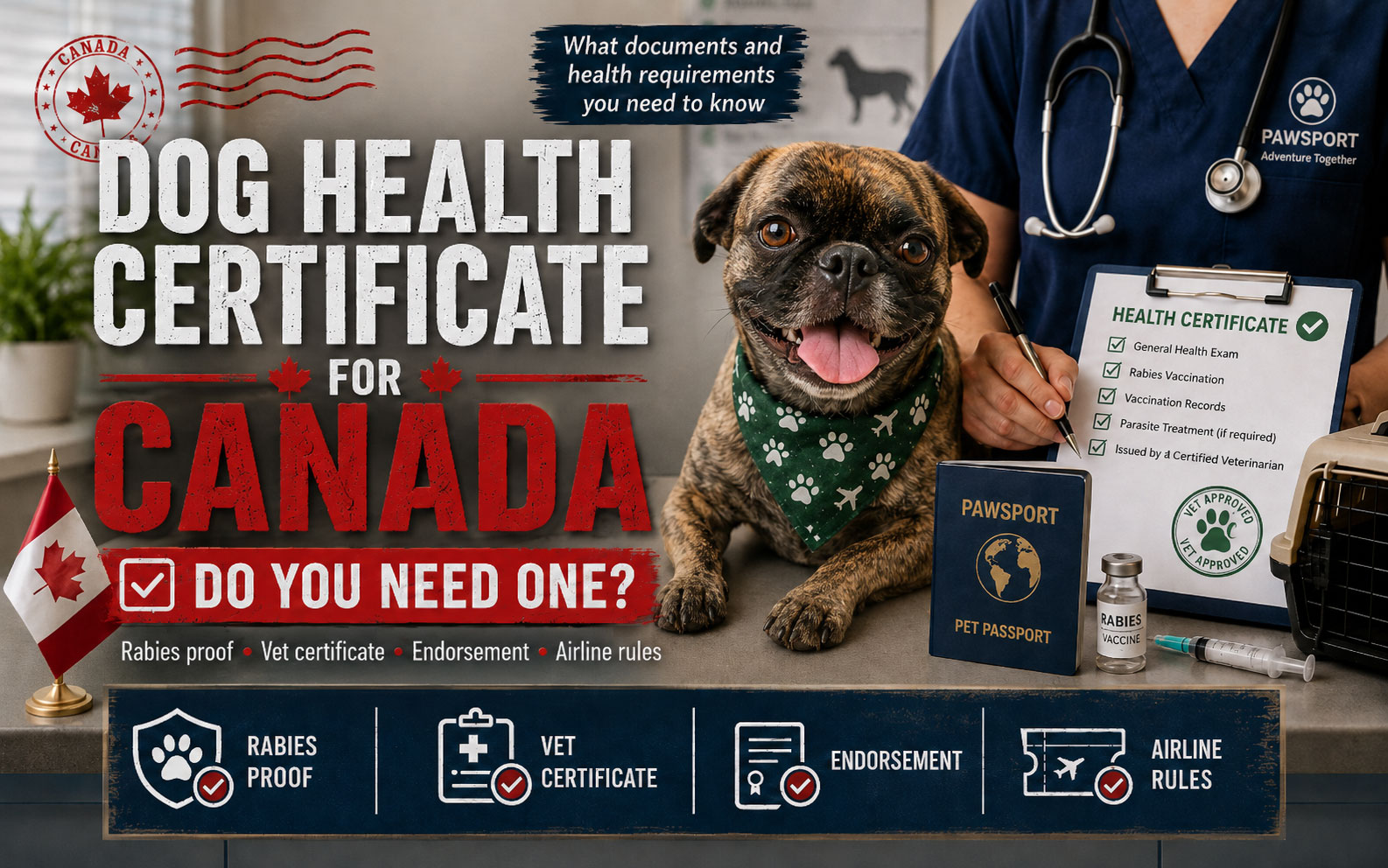
Dog health certificate for Canada
Open this if you need to know whether a certificate is required and who can issue it.

Flying to Canada with a dog
Choose this for general Canadian airport and airline, cabin, crate, and check-in rules.
How easy is it to bring your dog to Canada?
Flying with a dog to Canada is a relatively simple process especially if you are traveling with a personal pet and not importing commercially. In most cases you do not need an import permit, there is no quarantine, and the document requirements are minimal. The key requirement is a valid rabies vaccination. As long as your dog’s rabies certificate is current and properly documented, you should have no issues entering Canada.
There are two important situations where things will become more complex. First, Ontario has a province-wide ban on pit bulls, Staffordshire Bull Terriers, and similar mixes which can affect where you can legally travel and stay. Second, if you are bringing a rescue or recently adopted dog Canadian authorities may classify this as a commercial import instead of a personal pet. This triggers additional requirements such as an import permit, mandatory microchipping, and stricter documentation rules.
Upon arrival your dog and documents will be reviewed by Canadian border officials. In many cases the process is quick and easy. Only if something is missing or unclear will your dog be referred for further inspection which can cause delays.
Many personal trips are manageable once you know your dog’s category and paperwork requirements. If you want the next step start with the documents checklist and then confirm whether your trip needs a health certificate or airline-specific approval
Key requirements for bringing a dog to Canada
Canada’s dog entry rules depend on your dog’s age, country of origin, travel purpose, and whether your dog is traveling with you. For many personal pet trips the process is straightforward. But you still need to confirm your dog’s correct import category before you travel.
The most important starting point is rabies proof. From there check whether your dog’s age, travel category, airline, or next destination creates any extra paperwork.
Rabies proof
For personal pet dogs old enough to require rabies vaccination valid rabies proof is the core entry document.
Your rabies record should clearly identify your dog, show the vaccination date, and include the veterinarian or clinic information. If the record is incomplete, hard to read, or does not clearly connect to your dog it can create problems at the border or during airline check-in.
Age proof
If your dog is a puppy or if age affects your dog’s import category bring clear proof of age. This can include veterinary records, vaccination records, breeder paperwork, adoption records, or another document that clearly identifies your dog. For adult dogs with current rabies proof age is usually less of an issue. But for puppies it can matter.
Health certificate
Canada does not require a standard health certificate for every personal pet dog. Some dogs do need one depending on their age, travel purpose, origin country, or whether they are traveling with their owner. Your airline may also ask for veterinary paperwork even when Canada’s entry rule is simpler.
If you are unsure, check the Canada health certificate guide before making travel plans.
Airline paperwork
Your airline’s pet rules are separate from Canada’s entry rules. Your airline may require a pet reservation, cabin approval, cargo booking, carrier or crate check, health paperwork, or additional forms. Always check the airline’s pet policy for your exact route before you book.
Return or onward travel
Do not only plan for entering Canada. If your dog is leaving Canada and entering another country that next destination may require documents that Canada did not. This can include a health certificate, government endorsement, rabies documentation, microchip, parasite treatment, or import forms.
Want the Full Step-by-Step Guide?
This page covers the basics, but the full guide walks you through everything including exact timelines, documents, and airline requirements.
Get the full guideCommon mistakes to avoid
Assuming your dog qualifies as a “personal pet”
One of the biggest mistakes is assuming that all dogs quality under the simplified pet import rules. Rescued, adopted or rehomes dogs are often classified as commercial imports which come with stricter requirements such as import permits and microchipping.
Ignoring breed restrictions
The province of Ontario has a ban on pit bulls, Staffordshire Bull Terriers, and other similar mixes. Even if you can enter Canada local laws may impact where you can legally stay or travel.
Incorrect or incomplete rabies certificate
This is the most common issue. Missing details, wrong dates, missing a booster, or unclear information can cause problems at the border.
Relying on no health certificate needed
Even if Canada does not require a health certificate your airline or the country you are leaving might. Always confirm before travel.
What the Canada dog travel process looks like
The process is usually straightforward once you know your dog’s category. The key is to confirm the requirements in the right order before you travel.
1. Confirm your dog’s Canada import category
Start with the official CFIA pet import tool. Your dog’s requirements depend on age, country of origin, travel purpose, and whether your dog is traveling with you.
2. Check rabies proof and documentation
For many personal pet dogs valid rabies proof is the main document. Depending on your dog’s category you may also need age proof, a health certificate, airline paperwork, or return/onward travel documents.
For the full paperwork breakdown use the Canada documents checklist.
3. Confirm whether a health certificate applies
Canada does not require a health certificate for every dog, but some categories do. If the CFIA result says one is required check who can issue it, whether endorsement is needed, and how close to travel it must be completed.
4. Confirm your airline or border-crossing plan
If you are flying check your airline’s pet policy for your exact route. Airline rules are separate from Canada’s entry rules and can include carrier, crate, booking, check-in, and paperwork requirements.
If you are driving keep your dog’s documents easy to access at the border.
5. Prepare printed and digital copies
Bring printed copies of your dog’s key documents and keep digital backups on your phone. Printed paperwork is easier to show at airline counters, border crossings, and vet appointments.
6. Travel to Canada
At the airport or border be ready to show your dog’s documents if asked. If you are flying plan extra time because your airline may need to verify your pet booking, documents, carrier, or crate before travel.
7. Plan for leaving Canada
If your dog will enter another country after Canada check that country’s rules before you travel. Your return or onward destination may require documents that Canada did not.
Leaving Canada with your dog
Leaving Canada with a dog is generally straightforward. Canada itself has minimal exit requirements but you must meet the import rules of your destination country.
In most cases this requires visiting a veterinarian before departure to obtain a health certificate issued within the required timeframe. Some destinations may also require additional vaccinations or specific documentation depending on their rules.
If you are traveling to the United States the process is typically simple, especially for dogs that have been in Canada (a low-risk rabies country). In most cases the focus is on proof of rabies vaccination and adherence to current U.S. entry rules. Requirements have changed in recent years and can vary depending on where your dog was prior to entering Canada.
Planning ahead is key, particularly if your travel includes multiple destinations or stricter countries. Giving yourself enough time to confirm requirements and prepare documents helps avoid delays and issues at the border.
Driving to Canada with a dog
Driving to Canada with a dog is often easier than flying. The same core requirements apply; a valid rabies vaccination for dogs over 3 months of age.
At land borders inspections can vary. Some travelers will be waved through and others may be stopped by authorities to check the documentation and dog.
Keep in mind that breed restrictions and import classifications still apply regardless if you enter by air or land.

What’s it like in Canada with a dog?
Canada is an extremely dog-friendly country, especially in cities and outdoor-focused regions. Dogs are a normal part of everyday life. You’ll see them in parks, walking trails, patios, and neighborhoods across the country. People are generally respectful, welcoming, and comfortable around dogs.
One of Canada’s biggest advantages is access to nature. From mountains and forests, to lakes and open spaces, you have endless opportunities to explore with your dog. If you and your dog enjoy an active, outdoor lifestyle, Canada is one of the best places in the world to travel with your dog.
For us one of the standout places is Victoria BC. Beckham and I loved it. You will find dog parks everywhere, friendly owners walking their dogs through downtown, and a steady flow of dogs along the waterfront and Inner Harbour causeway. Vancouver Island in general is incredible for dogs with tons of outdoor space where they can run, explore, and just be dogs.
If you are looking to stay in a major city Toronto is a great option. It’s very dog-friendly with lots of parks and walking areas. One of the biggest perks is that dogs can ride public transit for free. It makes getting around the city and suburbs with your dog much easier.
Montreal is just as welcoming but with a different vibe. The city has plenty of green space and people are incredibly friendly. You will find many are happy to stop, say hello, and give your dog some attention. Beckham definitely appreciated all the extra pets.
Canada’s climate will play a big part in daily life with a dog. Winters can be harsh in many parts of the country which means adjusting your routine with shorter walks and protective gear. Summers on the other hand are perfect for being outside and exploring.
Overall Canada offers a great balance of structure, safety, and outdoor lifestyle. Whether you are in a major city or surrounded by nature it’s a place where you will find traveling with a dog is easy, natural, and enjoyable.
Ready to Plan Your Trip?
Get the complete step-by-step guide to bringing your dog to Canada including timelines, documents, and travel tips.
Get the Canada Dog Travel GuideFrequently asked questions
Can I take my dog on a flight to Canada?
Yes you can fly with your dog to Canada and it is generally a straightforward process. As long as your dog meets the entry requirements, and complies with the airlines rules, you should have no problems.
Do dogs have to quarantine after flying to Canada?
No, Canada does not require quarantine for compliant personal pet dogs. As long as your dog has a valid rabies vaccination and proper paperwork, you will be quickly cleared on arrival. Quarantine is only a risk if requirements are not met.
Can I bring my dog into Canada by car?
Yes, brining your dog into Canada by car is one of the easiest options. You will still need a valid rabies vaccination for dogs over 3 months of age. While checks at land border crossings can be minimal, you should always travel with all documentation in case you are asked for them.
Do I need a health certificate to bring my dog into Canada?
Not always. Canada does not require a health certificate for personal pet dogs. However your departure country or airline may require one.
Are pit bulls allowed in Canada?
Rules vary by province. Ontario has a province-wide ban on pit bull type dogs, including Staffordshire Bull Terriers and similar mixes. Even if entry is allowed into Canada, local laws can restrict where you can live or travel.
Official Resources
While this guide is designed to simplify the process, you can verify the latest requirements using official government sources below.
- Canadian Food Inspection Agency (CFIA) – Pet import rules and official entry requirements
- Canada Border Services Agency (CBSA) – What happens at the border and what officers can inspect or refuse
- USDA APHIS – Helpful if traveling to/from the United States