Traveling to Bolivia with a dog
🟢 Last Updated: June 2026
Bolivia is a memorable country to explore with a dog. It has high-altitude cities, salt flats, mountain scenery, colonial architecture, and some of the most unique landscapes in all of South America. It’s not the easiest destination to plan for and you need to be organized early.
This guide will help you understand the process, plan your dog’s trip, and avoid the common mistakes that can make international dog travel feel more stressful than it needs to be.
Bolivia Dog Travel QUICK Start
Requirement
Quick Answer
Difficulty
Hard
Health certificate
Required; issued and endorsed by the official animal-health authority of the exporting country
Rabies vaccine
Required and must be valid at time of entry
Titer test
Not required
Parasite treatment
Internal and external parasite treatment required within 30 days before travel
Microchip
Not required but strongly recommended
Import permit
Zoosanitary Import Permit required before export from the country of origin
Quarantine
Not required if paperwork and inspection are in order
Verification note: The official sources reviewed do not clearly state a specific time frame for the health certificate. Pawsport has contacted SENASAG to confirm this and will update this guide once written confirmation is received.
How easy is it to bring your dog to Bolivia?
Bolivia is a document heavy country to bring a dog to. The process includes official paperwork before travel, document review at entry, and a higher level of planning than countries with simpler entry. The biggest challenge is the timing and order. The import permit, official certificate, vaccine records, parasite treatment, Spanish-language information, and entry inspection are all one connected process. If you miss one step it can negatively impact your trip.
The key to a successful trip with your dog is start early and make sure your airline, route, and paperwork all line up.
Bolivia is best for travelers who are comfortable with a more formal process and careful preparation.
If you want a simple, low-paperwork entry, Bolivia is not that kind of destination.
Key requirements for bringing your dog to Bolivia
To bring your dog to Bolivia you will need an official import permit, zoosanitary certificate, vaccine records, parasite treatment, and Spanish-language documentation before travel.
Your dog will need:
- A Zoosanitary Import Permit before export from the country of origin
- An official zoosanitary certificate issued by the official animal-health authority of the exporting country
- Official endorsement or certification from the competent authority in the exporting country
- Rabies vaccination for dogs over 3 months old
- The listed vaccines given within 60 days before shipment
- Internal and external parasite treatment within 30 days before shipment
- Required information in Spanish
- Original documents ready for SENASAG review at the point of entry
- Clinical inspection by SENASAG when entering Bolivia
Keep in mind your dog may also need new paperwork before leaving Bolivia depending on how long your stay is and your next destination.
Want the Full Step-by-Step Guide?
This page covers the basics, but the full guide walks you through everything including exact timelines, documents, and airline requirements.
Get the full guide (Coming Soon)Flying to Bolivia with your dog
Flying to Bolivia with your dog takes more planning than countries with simpler pet entry rules. The process is document heavy, and your airline still has it’s own policies you have to keep in mind.
Before booking, confirm your airline’s cabin, checked baggage, cargo, carrier, breed, fee, and document rules. This is especially important for Bolivia because the import paperwork needs to be ready before your dog leaves. If you haven’t picked an airline yet, our airline dog policy database will help you narrow down the search.
Driving to Bolivia with your dog
If you are already traveling through South America, driving to Bolivia with your dog may be possible. Bolivia requires official import paperwork before entry, and your documents need to be ready before you reach the border. Land crossings can vary by route and even the officials on duty. This is why you need to keep the original paperwork close and give yourself extra time at the border. This is especially important if your route changes or your documents are close to a timing deadline.
Common mistakes to avoid
Avoid these mistakes:
- Waiting too long to start the import permit process. Bolivia requires a Zoosanitary Import Permit before export from the country of origin. This is not something to leave until travel week.
- Assuming a regular vet certificate is enough. Bolivia requires an official zoosanitary certificate issued by the official animal-health authority of the exporting country.
- Forgetting parasite treatment timing. Internal and external parasite treatment must be completed within 30 days before shipment.
- Not translating documents. Bolivia’s process requires Spanish-language information, so do not assume English-only paperwork will be accepted without issue.
- Not checking airline rules. Your airline may have its own approval process, document timing, carrier rules, breed restrictions, or cargo requirements.
- Keeping documents packed away. Keep your dog’s permit, certificate, vaccine records, parasite treatment details, and supporting documents easy to access at check-in, transit, and the point of entry.
What the Bolivia dog travel process looks like
Bringing your dog to Bolivia is about getting the official steps in the right order before you travel. Unlike simpler destinations, Bolivia requires planning before your dog leaves the country of origin.
The basic process looks like this:
- Confirm Bolivia’s current dog entry requirements.
- Check your dog’s rabies and vaccine records.
- Confirm the vaccine timing needed for Bolivia.
- Schedule internal and external parasite treatment within the required window.
- Prepare the official zoosanitary certificate with the competent authority in the exporting country.
- Apply for the Zoosanitary Import Permit before export.
- Make sure the required information is available in Spanish.
- Print the permit, certificate, vaccine records, parasite treatment details, and supporting documents.
- Keep everything ready for airline check-in, land border review, and SENASAG inspection when entering Bolivia.
Leaving Bolivia with your dog
The documents you used to enter Bolivia do not automatically make your dog ready for the next country. You may need a new veterinary appointment, a new export certificate, official endorsement, updated parasite treatment, import authorization, or additional testing.
Before you leave Bolivia, confirm the next country’s requirements and build in enough time for fresh paperwork if needed.
What Bolivia is like with a dog
Boilvia with your dog is an incredible experience you won’t forget. The landscapes are unforgettable, the culture is rich, and the pace is perfect if you are a slow traveler. Daily dog logistics need to also take into account the altitude, infrastructure, transport, and city conditions.
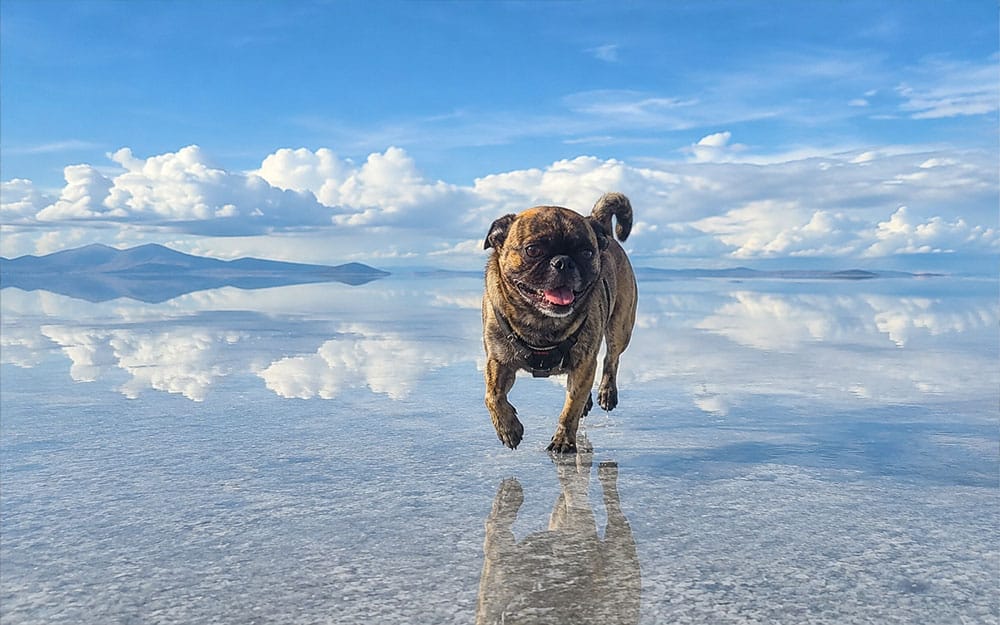
La Paz is the most dramatic base, but it can also be one of the more challenging places with a dog. Its high altitude, steep streets, and traffic means your daily walks will need more planning than in flat or more relaxed cities. If you have a flat-faced dog like Beckham, if your dog is older, or sensitive to altitude or physical exertion you will want to be extra careful.
Santa Cruz is a practical location for dog owners since the low altitude is easier on the body than La Paz. The tradeoff is heat, humidity, traffic, and neighborhood differences, so you will still need to choose the right accommodation and walking routine.
Smaller cities and colonial areas such as Sucre are excellent if you want a slower stay. These places are less intense than La Paz, but you have to consider things like veterinary care, pet supplies, sidewalks, stray dogs, and transportation before settling in.
One final thing about Bolivia. Moving between destinations may be harder on your dog. Long overland routes, high-altitude roads, limited pet-friendly transport, and changing conditions can make it more complicated than simply flying in and staying in one place.
Bolivia is best for experienced travelers comfortable adapting to local conditions. It is not the easiest choice for a first international dog trip or for travelers who want a smooth, low-effort routine.
Ready to Plan Your Trip?
Get the complete step-by-step guide to bringing your dog to Bolivia including timelines, documents, and travel tips.
Get the Bolivia Dog Travel Guide (Coming Soon)Frequently asked questions
Can I bring my dog to Bolivia?
Yes, you can bring your dog to Bolivia, but the process is more document-heavy than many other South American countries. You need to prepare the import permit, official zoosanitary certificate, vaccine records, parasite treatment details, and supporting documents before travel.
Does Bolivia require an import permit for dogs?
Yes. Bolivia requires a Zoosanitary Import Permit before export from the country of origin.
Does Bolivia quarantine dogs on arrival?
Bolivia does not list routine quarantine for every compliant pet, but SENASAG may require quarantine if there are clinical concerns, document issues, or other entry problems.
Official Resources
While this guide is designed to simplify the process, you can verify the latest requirements using official government sources below.
- SENASAG / VUCE Bolivia: Requirements for importing dogs and cats
- SENASAG / VUCE Bolivia: Procedure for importing dogs and cats