How to Bring a Dog to Singapore
🟢 Last Updated: July 2026
Singapore is a great country to experience with your dog if you are wanting a clean, organized, city-focused trip with easy access to parks, waterfront walks, pet services, and modern amenities. From neighborhood cafes and green spaces to Marina Bay, Sentosa, and the quieter residential areas, it works well for dog owners who are comfortable planning ahead.
This guide will help you to understand the process so you can plan your dog’s trip, and avoid the common mistakes that can make a trip to Singapore more stressful than it needs to be.
Singapore Dog Travel QUICK Start

Requirement
Quick Answer
Difficulty
Hard
Health certificate
Required within 7 days before travel; must be government endorsed
Rabies vaccine
Not required for Schedule I; required for Schedule II and Schedule III
Titer test
Required for Schedule II and Schedule III
Parasite treatment
Internal and external parasite treatment required between 2 and 7 days before export
Microchip
Required; ISO 11784 or ISO 11785
Import permit
Required; apply within 90 days before travel
Quarantine
Schedule I has no quarantine, Schedule II may avoid quarantine if conditions are met, Schedule III requires quarantine
Breed restrictions
Singapore bans several breeds and crosses of listed breeds
How easy is it to bring your dog to Singapore?
Singapore can be hard to bring a dog depending on your dog’s origin schedule. If your dog is coming from a lower-risk country it will have a much easier path than a dog coming from a Schedule III country where quarantine and longer timing rules apply.
The main challenge people have is sequencing. The microchip, rabies vaccine, rabies serology, health certificate, parasite treatment, import licence, Customs permit, inspection booking, pet agent, and possible quarantine all need to line up for your arrival date. This is the kind of destination where the process is much easier when every step is organized clearly in one place.
Singapore isn’t a country you should treat casually. Start early, confirm your dog’s schedule category, and then work backward from your travel date before booking anything that you can’t change.
What do Schedule I, Schedule II, and Schedule III mean?
Singapore groups exporting countries and areas into rabies risk schedules. This means your dog’s schedule will be based on the county or region they are leaving from. The schedule will affect the rabies rules, serology timing, quarantine status, and overall time needed to plan your trip.
Schedule I countries and regions are the lowest rabies-risk category. Dogs from Schedule I countries have the easiest path because rabies vaccination and rabies serology are not required for this category.
Schedule II countries and regions are treated as lower-risk, but not the same as Schedule I. Dogs from Schedule II countries need rabies vaccination and rabies titer tests. They may be able to avoid quarantine if all conditions are met.
Schedule III applies to any country or region not listed under Schedule I or Schedule II. Dogs from Schedule III countries have the strictest path, including rabies vaccination, rabies antibody serology, and quarantine planning.
This is why the first thing you should do when planning a trip to Singapore with your dog isn’t booking your flight. The first step should be to confirm which schedule your dog will fall under. Once you know this, you can work backwards from your arrival date and plan the right vaccine, serology, permit, inspection, pet agent, and quarantine steps.
Key requirements for bringing your dog to Singapore
To bring your dog to Singapore, the main things to plan are the microchip, origin schedule, rabies rules, serology if required, dog licence, import licence, Customs permit, health certificate, parasite treatment, inspection appointment, pet agent, and quarantine status.
Your dog will need:
- To be at least 12 weeks old at export
- An ISO-compliant microchip
- A confirmed Singapore schedule category based on the exporting country or region
- A dog licence before applying for the import licence
- A Singapore import licence
- A Customs In-Payment GST permit before arrival
- A border-control inspection appointment booked before arrival
- An AVS-recognised pet agent for Changi arrivals
- A government-endorsed veterinary health certificate
- A clinical exam within the required pre-export window
- Valid core dog vaccine records
- Rabies vaccination if traveling under Schedule II or Schedule III
- Rabies antibody serology if traveling under Schedule II or Schedule III
- Internal and external parasite treatment between 2 and 7 days before export
- Original documents ready for AVS inspection on arrival
- Quarantine planning if your dog’s schedule or circumstances require it
Singapore does not use one simple rule for every dog. Your dog’s origin schedule controls several of the most important steps, especially rabies vaccination, serology, quarantine, and timing.
Want the Full Step-by-Step Guide?
This page covers the basics, but the full guide walks you through everything including exact timelines, documents, and airline requirements.
Get the full guide (Coming Soon)Flying to Singapore with your dog
One of the most common ways people travel to Singapore with their dog is by flying. It is also one of the most structured airport processes in all of Asia. If your dog will be arriving through Changi, import clearance must be handles through and AVS-recognized pet agent.
Before booking, make sure to confirm your airline’s cabin, checked baggage, cargo, carrier, breed, fee, and document rules. Airline approval is completely separate from Singapore’s AVS import process and both need to work with your dog’s schedule category, permit timing, health certificate, and arrival inspection appointment.
If you haven’t picked an airline yet, have a look at our airline dog policy database. It is a handy tool that can help you narrow down your search and pick the best airline for your situation.
Driving to Singapore with your dog
Driving to Singapore with your dog may be possible if you are entering form Malaysia. It still requires the same careful advance planning as air travel. You will still need the correct Singapore import documents, health certificate, parasite treatment, customs permit, or AVS inspection.
Dogs entering by land are inspected at the designated land checkpoint which means your arrival timing and inspection booking matter. Keep your dog’s original documents easy to reach, and make sure the import licence, health certificate, parasite treatment, and border appointment all match your actual entry date.
Common mistakes to avoid
Most issues when bringing a dog to Singapore come from misunderstanding the schedule system, missing a timing step, or assuming the import licence is the only approval needed.
Avoid these common mistakes:
- Not checking your dog’s schedule category first. Singapore’s rules depend heavily on whether your dog is coming from Schedule I, Schedule II, or Schedule III.
- Missing the rabies serology timeline. Schedule II and III dogs need rabies serology, and the blood sample timing can add months to the process.
- Applying for documents in the wrong order. The dog licence, import licence, Customs permit, inspection booking, health certificate, and parasite treatment all need to be planned in sequence.
- Forgetting the inspection appointment. Singapore requires a border-control inspection appointment before arrival.
- Ignoring the pet agent requirement. Changi arrivals require an AVS-recognised pet agent for import clearance.
- Getting parasite treatment timing wrong. Internal and external parasite treatment must be completed between 2 and 7 days before export.
- Assuming quarantine doesn’t apply. Quarantine depends on the schedule category and whether your dog meets the conditions for release.
- Overlooking breed restrictions. Singapore bans several breeds and crosses of listed breeds, so this needs to be checked before travel.
- Relying only on airline approval. Your airline can approve your dog for travel, but that does not replace Singapore’s AVS import rules.
- Keeping documents packed away. Keep your dog’s import licence, Customs permit, health certificate, vaccine records, serology report if required, microchip details, and inspection booking information easy to access.
If you avoid these schedule, timing, and document mistakes, Singapore is possible to plan with a dog, but it needs more organization than many destinations.
What the Singapore dog travel process looks like
Bringing your dog to Singapore is mostly about identifying the correct schedule pathway and working backward from your arrival date.
The basic process looks like this:
- Confirm your dog’s exporting country or region.
- Check whether your dog falls under Schedule I, Schedule II, or Schedule III.
- Confirm your dog is at least 12 weeks old at export.
- Check your dog’s ISO microchip details.
- Confirm your dog’s core vaccine records.
- Complete rabies vaccination if required for your dog’s schedule.
- Plan rabies serology if your dog is traveling under Schedule II or Schedule III.
- Apply for a Singapore dog licence.
- Apply for the Singapore import licence within the correct pre-arrival window.
- Obtain the Customs In-Payment GST permit before arrival.
- Book the border-control inspection appointment.
- Engage an AVS-recognised pet agent if arriving through Changi.
- Schedule internal and external parasite treatment between 2 and 7 days before export.
- Complete the veterinary health certificate and government endorsement.
- Confirm your airline’s pet rules if flying.
- Print your dog’s import licence, Customs permit, health certificate, vaccine records, serology report if required, microchip details, and inspection booking information.
- Present your dog and documents for AVS inspection on arrival.
- Complete quarantine or release steps based on your dog’s schedule and compliance status.
Leaving Singapore with your dog
Leaving Singapore with your dog needs its own planning, especially if Singapore is part of a longer Asia trip. The documents used to enter Singapore do not automatically work for the next country. Depending on where you are going next, you might need a new veterinary appointment and exam, an export certificate, government endorsement, updated parasite treatment, import authorization, rabies titer test, or quarantine booking. Your next destination may also have strict timing rules you need to account for.
Before you leave Singapore, confirm the next country’s requirements and make sure to give yourself enough time to prepare new paperwork if needed.
What Singapore is like with a dog
Singapore can be a very comfortable place to relocate or travel with a dog once the entry process is behind you. It is clean, safe, organized, and easy to navigate when compared to other countries. It is also highly regulated, urban, expensive, and hot year-round.
Singapore is a city-state, so the decision on where to stay comes down to choosing the right neighborhood instead of choosing between different cities. Areas with easy green space access, quiet streets, dog-friendly housing, and nearby veterinary care all make daily life much easier. Neighborhoods near waterfront paths or quieter residential areas are more practical with a dog than the dense commercial areas with heavy pedestrian traffic and limited outdoor space for your dog to relieve themselves.
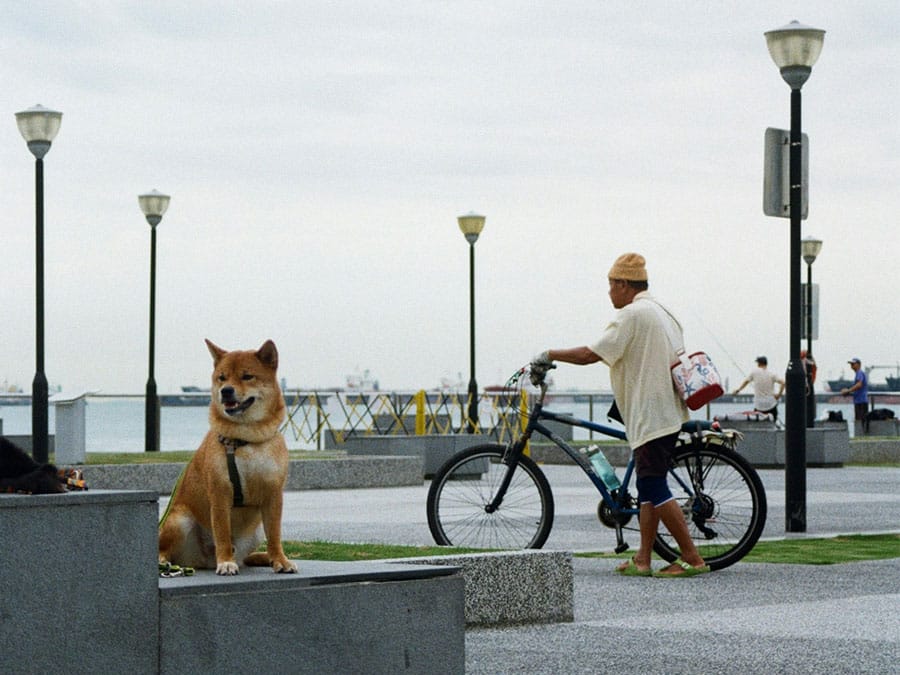
Some of the most popular areas for dog owners include East Coast Park, River Valley, Holland Village, Bukit Timah, Katong, Tanjong Pagar, Sentosa, and other neighborhoods with better access to parks, walking routes, and dog-friendly cafes. The best choice for you will come down to your budget and how easy your dog handles heal, elevators, traffic, and busy sidewalks.
Getting around with a dog requires planning. Singapore’s public transit is world class for people but dogs are not allowed. Taxis, rideshare, and rentals are the most practical options. Always make sure you confirm your dog is allowed when you are booking a ride.
Walking is a part of daily dog life in Singapore but when you walk matters. The weather is hot and humid year-round, so morning and evening walks will be the most comfortable for your dog. Midday walks can become uncomfortable or risky, especially for older dogs, flat-face breeds, or dogs that overheat quickly. If you have to go out midday, shade, water, and keeping your walk short is a must.
Dog culture in Singapore is responsible and structured. Most people are comfortable around dogs and you will see lots of well cared for and groomed dogs, dog owners and their dogs at parks, and a strong pet services industry. Always helps to keep in mind that not everyone is a “dog person” and keeping your dog leashed, under control, quiet in shared spaces, and respectful around other people is important.
Vet clinics, groomers, pet shops, boarding facilities, pet taxis, and specialty services are easier to find than in many nearby countries. The trade-off is cost. Veterinary care, grooming, pet food, dog-friendly housing, and pet transport can be expensive.
Not every building, condo, or rental allows dogs and some may have size, breed, or number or dog restrictions. Always confirm the pet policy before booking, especially for longer stays.
Singapore can be strict when it comes to the breed of dog. Some are banned or restricted, and housing or transport providers may have their own rules to navigate. If your dog is a larger breed, restricted breed, or a breed that is often misunderstood, confirm the import rules and housing options before making plans.
Singapore is not the easiest country to enter, and it is not the cheapest place to live with a dog, but once you are there the safety, cleanliness, services, and predictability make daily life feel much easier.
Ready to Plan Your Trip?
Get the complete step-by-step guide to bringing your dog to Singapore including timelines, documents, and travel tips.
Get the Singapore Dog Travel Guide (Coming Soon)Frequently asked questions
Can I bring my dog to Singapore?
Yes, you can bring your dog to Singapore if your dog meets the AVS import requirements. The exact process depends on your dog’s origin schedule, microchip, vaccines, rabies serology if required, import licence, inspection booking, and quarantine status.
Is Singapore hard to travel with a dog?
Singapore is hard because the process is schedule-dependent and document-heavy. The rules are clear, but there are several steps that need to be completed in the right order before arrival.
Does Singapore require a rabies titer test for dogs?
A rabies antibody titer test is required for dogs traveling under Schedule II and Schedule III. It is not required for Schedule I dogs.
Do I need a pet agent to bring my dog to Singapore?
For Changi arrivals, AVS requires pet owners to use an AVS-recognized pet agent for import clearance procedures.
Official Resources
While this guide is designed to simplify the process, you can verify the latest requirements using official government sources below.
- Animal & Veterinary Service Singapore: Importing dogs and cats
- Animal & Veterinary Service Singapore: Changi Animal & Plant Quarantine Station