Flying with your dog to Mexico City (CDMX)
🟢 Last Updated: April 2026
For a lot of people and their dogs Mexico City is the entry point into Mexico. Some find it intimidating. New airport, new system, and a busy city. In reality it is easier than it seems.
With a central airport, great neighborhoods, and a generally dog-friendly culture CDMX is a good destination to travel with your dog.
👉 If you’re planning your trip start here: flying with your dog to Mexico
Based on real travel experience with my dog Beckham in Mexico City
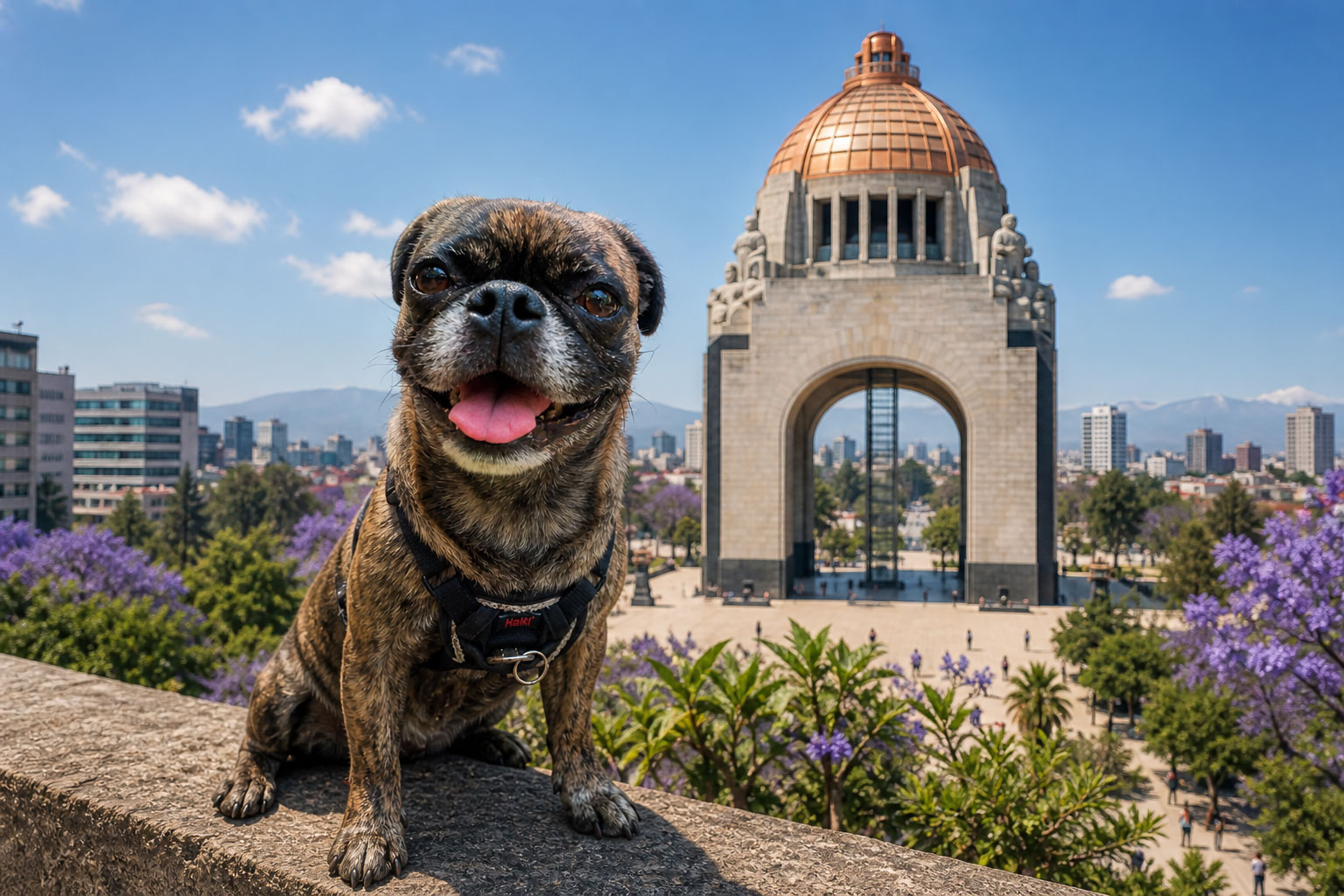
Arriving in Mexico City with your dog
Most travelers arriving in Mexico City land at Benito Juárez International Airport (MEX). This is the main airport serving the city and the one most international flights use. After you land with your dog you will go through immigration and then collect your luggage. If your dog traveled in the hold you will need to collect them and then proceed to the SENASICA inspection area. Officials will inspect your dog and make sure they are healthy and free of visible signs of illness or parasites. This is usually quick and simple.
Mexico City has a second international airport Felipe Ángeles International Airport (NLU). It’s a newer airport located about 45 km outside the city. While it does handle some international flights this airport is more focused on cargo and select routes. If you are booking a flight to Mexico City I would double check which airport you have selected. Arriving at Felipe Ángeles instead of Benito Juárez adds significant travel time into the city. Something to consider when you have luggage and your dog with you.
Getting from the airport into the city
One of the biggest advantages of Mexico City is how close Benito Juárez Airport is to the city itself. Unlike many international airports it is inside the city. This makes getting to your accommodation relatively straightforward. Beckham and I used Uber the first time and it was super simple. Open the app, no guesswork and direct to our place.
By about the fourth time flying into CDMX I preferred using the metro. The metro system stops at the airport and often is significantly faster than an Uber. Traffic in Mexico City is unpredictable. I’ve been in an Uber with Beckham expecting a 45-minute drive only to watch it turn into a two-hour trip after hitting the start of rush hour.
One thing with the metro, you will be asked for service dog documentation if your dog is outside of a carrier. I was asked every time we took the metro. It wasn’t a problem they took a picture of the digital card I have on my phone and waved us through.
If you are arriving late at night and have lots of luggage or are unfamiliar with the city, you might want to take a taxi or Uber. If you and your dog are comfortable navigating public transportation the metro is a very practical option.
What’s it like living in Mexico City with a dog
Mexico City has a strong dog culture. Beckham and I spent a few months here and dogs are just a part of life here. It was normal for us to see dogs in the park, with their owners at a cafe or walking through the neighborhood. In some areas like Roma and Condesa it almost felt expected to have a dog.
Day-to-day life was easy. We were out walking at all times of the day and never had any issues. There’s a lot happening at any given moment and that’s something to be aware of. Mexico City is busy and for a dog like Beckham it can be overstimulating. This is one of the reasons I always kept Beckham on a leash. It makes navigating traffic, large crowds, and random noises much easier. It also helped with street dogs since Beckham wants to go say hi and have a sniff and I prefer to hold him back until I see the tail wagging.
We also spent some time outside the main areas including Tultepec. It was a completely different experience. Quieter and less hectic which is appealing but there were negatives. The biggest was the nightly fireworks which can be stressful for dogs. It is also a long journey to get into the main parts of the city. This contrast is a great example of how your experience in Mexico City really depends on where you stay.
That contrast really highlights how much your experience in Mexico City depends on where you stay. In neighborhoods like Roma and Condesa everything is within walking distance and super dog-friendly. Outside of those areas it can be a much different environment.
Best neighborhoods in Mexico City for traveling with a dog
Roma & Condesa
If you are looking to live in Mexico city with your dog Roma and Condesa are by far the easiest neighborhoods. They’re extremely walkable, filled with parks, and designed in a way that makes day-to-day life simple. Sidewalks are wide, there’s constant foot traffic, and it’s normal to see dogs everywhere. You will see dog’s sitting on the patio with their owners at a cafe or restaurant.
From experience with Beckham this is where everything just felt easy. We could step outside and immediately be in a dog-friendly environment. We enjoyed grabbing a coffee on a patio, walking around the neighborhood, and especially meeting other dogs at Parque México. If this is your first time in Mexico City with your dog, this is where you’ll feel the most comfortable.
Polanco
Polanco offers a different experience. It’s more upscale, cleaner, and very well maintained which will be appealing if you’re looking for a quieter and more structured environment. It is dog-friendly but in a more polished way. You’ll find good green spaces, wide sidewalks, and access to high-quality services like vets and pet stores. It doesn’t have the same casual dog culture as Roma or Condesa, but it’s very easy to navigate with a dog and feels safe and predictable.
Juárez
Juárez sits somewhere in between. It gives you central access to a lot of the city without being as busy or dense as Roma or Condesa. It’s a good option if you want convenience but a slightly more relaxed pace. Walking with a dog here is still manageable and you’re close to key areas. It doesn’t have quite the same concentration of parks and dog focused spaces however.
Dog-friendly accommodation in Mexico City
In most cases, Airbnb is the easiest and most flexible option when traveling with a dog in Mexico City. You will find places with more space, fewer restrictions and easier access to outdoor areas. Many listings, especially in Roma and Condesa, are pet-friendly which makes booking straightforward.
From experience, though, there’s one important detail worth noting. Even though platforms like Airbnb and Booking.com have policies that allow service dogs, not every host is familiar with them — or willing to follow them. I had one place cancel and another refuse Beckham outright. I quickly realized that relying on policy alone isn’t always worth the hassle.
Because of that, I now specifically filter for “pet-friendly” listings, even if it costs slightly more. It avoids the back-and-forth and makes the entire process much smoother.
Hotels can work, but policies vary, and you’re more likely to run into size restrictions or additional fees.
Dog parks and outdoor spaces in Mexico City
Mexico City has a surprising amount of green space.
Parque México became one of our regular spots. It’s centrally located, easy to access, and always full of dogs which makes it great for walking and socializing. It’s one of those places where you immediately feel how dog-friendly the city is. We also spent time at Parque Naucalli which is a completely different experience. It’s larger, less crowded, and has more open space. One of the highlights was watching other dogs use the agility course. Beckham was completely fascinated by it.
Another standout was Parque de los Venados. It is especially good in the mornings. There is a fenced dog area that fills up with people and their dogs. It felt more community-driven and it was a great spot for relaxed socialization.
Restaurants and Cafes in Mexico City with a dog
One of the most surprising things about Mexico City is how relaxed and open to dogs many restaurants and cafes are. In the right neighborhoods, especially Roma and Condesa, it’s very common to see dogs sitting beside their owners at outdoor tables. One of our regular spots was Bago Cafe where Beckham quickly figured out that a pup cup was always waiting for him. It’s small details like that that make the experience feel welcoming rather than restrictive.
The experience isn’t the same across the entire city. Some places are more accommodating to dogs than others.
Getting around Mexico City with a dog
Walking
Walking is often the easiest way to get around. Especially in neighborhoods like Roma and Condesa where everything is close together.
Sidewalks are generally good and there is always a lot within walking distance. This makes day-to-day life simple with a dog. Just remember that Mexico City is busy and there’s always a lot going on. Keeping your dog on a leash makes a big difference. Not just for navigating crowds and traffic, but also for dealing with the occasional street dog. Most are harmless, but every now and then you may come across one that’s a bit more territorial or aggressive.
Uber / Taxi
Uber is widely available and one of the easiest ways to get around with a dog. In Mexico City, Uber Pet is also available which is the best option if you’re traveling with a larger dog. For smaller dogs regular Uber rides are usually fine but it depends on the driver.
Taxis are generally accommodating but not guaranteed. Some will have no problem taking a dog while others may refuse. So it’s a bit less predictable compared to Uber. For longer distances or when you want the simplest option Uber is usually the most reliable choice.
Public Transportation
Public transportation in Mexico City is extensive and very affordable. But it has it’s limitations when traveling with a dog. In general dogs are not allowed unless they are service animals or are transported in a carrier. From our experience, service dogs are accepted but you should expect to be asked for documentation, especially on the metro.
The metro itself can be useful but it gets extremely crowded. Particularly during peak hours. If your dog isn’t comfortable in tight, busy environments, it’s best to avoid it during those times.
Collectivos (shared vans) can be another option and in my experience they are more relaxed about dogs. They can get very crowded, so it’s not always the most comfortable choice.
Vet access and pet services in Mexico City
Access to veterinary care in Mexico City is very good, especially in central neighborhoods. You’ll find plenty of clinics, pet stores, and grooming services.
From experience one of the best options we used was Mobile Pet Vet Mexico City. They came directly to us, were extremely knowledgeable, spoke English, and made the entire process of getting Beckham prepared for our next trip smooth and stress-free. Pricing was also very fair which made it an easy choice.
Final thoughts
If you are thinking about traveling to Mexico with your dog, Mexico City is a great place to start your journey. Once you understand the airport, choose the right neighborhood, and plan your transportation the experience is very enjoyable.
Mexico City caught your eye?
If Mexico City feels like the kind of city you’d love to visit with your dog, the Mexico Dog Travel Guide for 2026 will help you get there with less guesswork.
Get the Mexico guide & checklistFrequently asked questions
Is Mexico City dog friendly?
Yes, especially in neighborhoods like Roma and Condesa where dogs are part of everyday life.
Can dogs go in restaurants in Mexico City?
Many places allow dogs, especially in outdoor seating areas.
Is Uber dog-friendly in Mexico City?
Generally yes. Most drivers are accommodating, especially with smaller dogs.
Is public transportation dog friendly in Mexico City?
It can be restrictive depending on the situation, and is not always the most convenient option.
Is Mexico City a good place to travel with a dog?
Yes. With the right planning, it’s one of the more accessible and dog-friendly major cities.