Dog Weight Limits for Flying in Cabin
One of the first questions people ask before flying with a dog is simple: How much can my dog weigh to fly in the cabin?
Unfortunately airline rules are not always that simple.
Some airlines have a clear cabin weight limit. Others do not publish a specific dog weight limit at all. Instead they care about whether your dog fits comfortably inside an approved carrier under the seat in front of you.
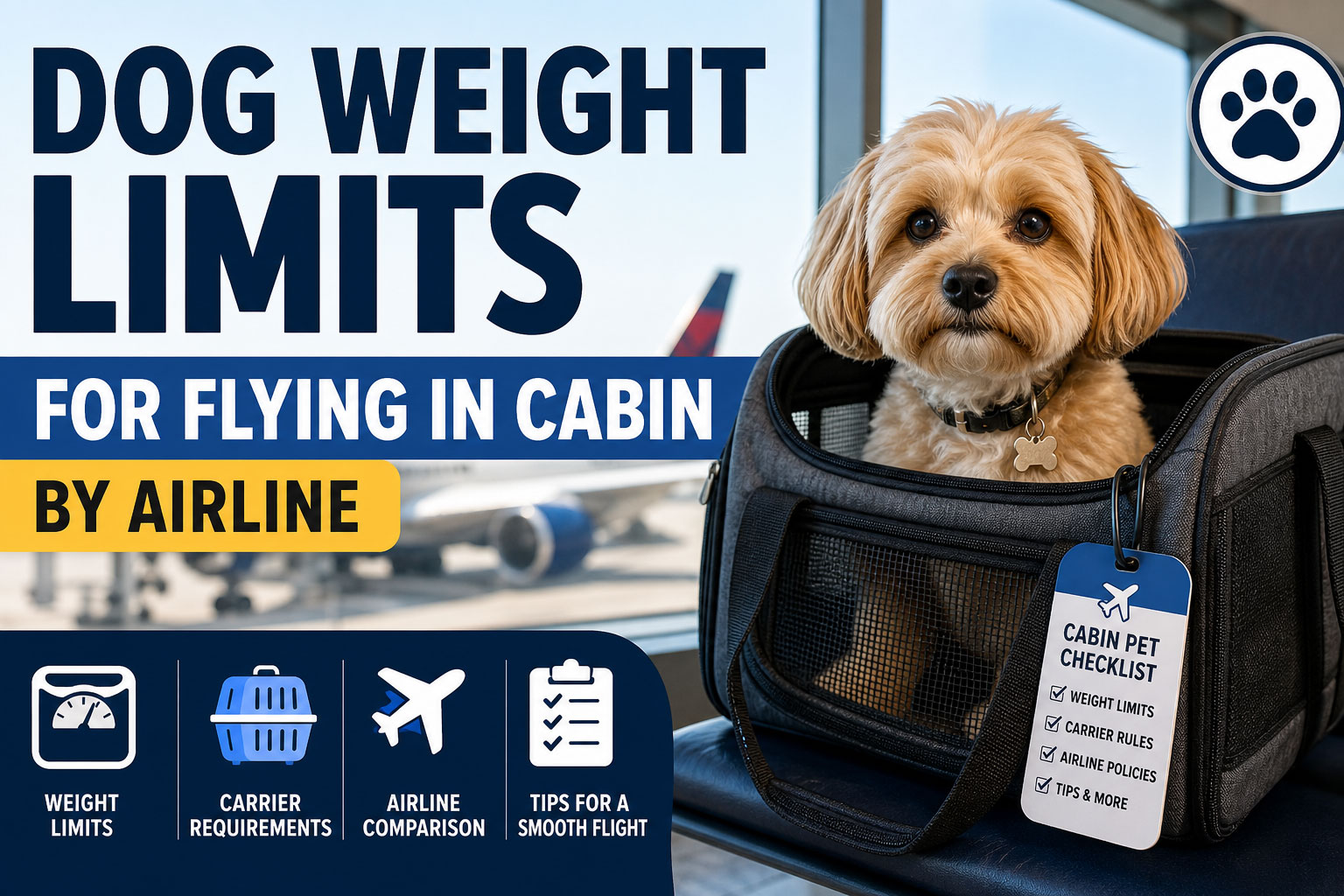
That difference matters. A compact 18 lb dog may fit nicely in a soft-sided carrier. A taller 15 lb dog may not. And on airlines with a combined weight limit the carrier counts too.
In this guide we’ll break down the dog weight limit for cabin flights by airline. Explain what actually happens at check-in and help you figure out whether your dog is small enough to fly under the seat.
Is there a standard dog weight limit for in-cabin flights?
There is no universal weight for dogs flying in the cabin. Each airline sets its own rules. Some airlines use a strict combined weight limit for your dog and carrier. Other airlines focus entirely on carrier size and whether your dog can stand, turn around, and lie down comfortably inside the carrier. That means you should not assume that “under 20 pounds” automatically means your dog can fly in the cabin.
For most airlines the real test is:
- Can your dog fit fully inside the carrier?
- Can the carrier fit under the seat in front of you?
- Can your dog stay inside the zipped carrier for the entire flight?
- Does the dog and carrier stay under the airline’s weight limit, if one exists?
If your dog is close to the limit, the carrier test matters just as much as the number on the scale.
| Airline | Cabin Dog Weight Limit | Does Carrier Count? | What Actually Matters |
|---|---|---|---|
| Air Canada | No simple published cabin weight limit | Carrier fit matters | Dog must fit comfortably in a soft-sided carrier under the seat. |
| Alaska Airlines | No simple published cabin weight limit | Carrier fit matters | Small dogs may fly in cabin if they fit in an approved under-seat carrier. |
| Avianca | 10 kg / 22 lb | Yes | Dog and carrier together must not exceed the combined limit. |
| American Airlines | 20 lb / 9.07 kg | Yes | American says the pet and carrier are weighed together at check-in. |
| Delta Air Lines | No simple published cabin weight limit | Carrier fit matters | Dog must fit comfortably in a kennel under the seat without touching or sticking out. |
| United Airlines | No weight limit | Carrier fit matters | United says there are no weight or breed limits, but pets must fit in an approved carrier. |
| Southwest Airlines | No simple published cabin weight limit | Carrier fit matters | Small dogs and cats must stay in an approved carrier for the entire flight. |
| JetBlue | Commonly listed as 20 lb including carrier | Yes | Pet and carrier must fit under the seat; confirm current weight rules before booking. |
| Frontier Airlines | No simple published cabin weight limit | Carrier fit matters | Carrier must fit under the seat and allow the pet to stand, turn around, and lie down. |
| Lufthansa | 8 kg / 17.6 lb | Yes | Dog and carrier together must not exceed the combined cabin limit. |
| KLM | 8 kg / 17.6 lb | Yes | Dog and travel bag or kennel together must not exceed the combined limit. |
| Air France | 8 kg / 17.6 lb | Yes | Dogs over the cabin limit generally need to travel in the hold, where allowed. |
Airline pet policies can change, and aircraft layouts vary. Always confirm your dog’s eligibility directly with the airline before booking.
Dog weight limits for cabin flights by airline
The table above gives you the quick version, but the details matter. Some airlines are strict about the total weight of your dog and carrier. Others are more concerned with whether your dog fits properly under the seat.
Here is how the major airlines compare.
Air Canada dog weight limit for cabin flights
Air Canada’s dog in-cabin pet policy is not built around one simple weight limit. Air Canada says your small dog must be kept in a flexible, soft-sided carrier under the seat in front of you. Your pet must be small enough to stand, turn around, and lie down inside the carrier.
That means Air Canada is more of a carrier-fit airline than a strict weight-limit airline.
This is important because a dog’s shape often matters more than the number on the scale. A compact dog is easier to fly with than a taller dog that weighs less but cannot comfortably settle inside the carrier.
Air Canada requires you to contact reservations after booking your flight to register your pet. When you call they will confirm your carrier dimensions and your dog’s weight and breed. Pets that are not registered in advance may not be accepted at the airport. This means you should not just show up at check-in and hope it works.
Alaska Airlines dog weight limit for cabin flights
Alaska Airlines is more focused on carrier fit than a published dog weight limit. Small dogs can travel in the cabin if they fit in an approved pet carrier. Alaska also limits cabin pet space so availability matters. This makes Alaska one of the better airlines if your dog is small enough for the cabin but does not fit into a strict weight-limit category.
That does not mean small dogs automatically get approved. Your dog still needs to fit inside the carrier in a safe and reasonable way. If your dog is pressed against the top, cannot turn around, or clearly looks too large for the carrier you will probably run into problems.
The biggest mistake people make with Alaska is assuming no hard weight limit means any dog that fits under the seat is fine. The airline still has to accept the carrier. The dog needs to remain fully inside the carrier. And the seat in front of you has to have enough space under it for the carrier.
Avianca dog weight limit for cabin flights
Avianca is much clearer than many airlines because it publishes a specific cabin weight limit. Dogs and cats may travel in the cabin only if they weigh no more than 10 kg / 22 lb including the carrier. Avianca also has specific carrier requirements. The carrier must be soft-sided, fit under the seat, and allow your dog to stand, turn around, and move naturally. Avianca’s help page also lists a maximum carrier size of 22 × 14 × 10 in / 56 × 36 × 25 cm.
Avianca is a great choice for dog travel in Latin America especially if you are connecting through Colombia.
American Airlines dog weight limit for cabin flights
American Airlines has one of the clearest cabin pet weight rules. The total weight of your pet and carrier must not exceed 20 lb / 9.07 kg. American says they will weigh them at check-in. This is stricter than some travelers expect and it is a total combined weight of dog and carrier.
American is not the airline where I would try to “sneak by” with a borderline dog. American can work well for very small dogs, but if your dog is close to 20 lb before the carrier you should probably compare other airlines.
Delta dog weight limit for cabin flights
Delta does not publish a simple cabin dog weight limit in the same way American or Avianca does. Your dog must be small enough to fit comfortably in a kennel with the ability to move around without touching or sticking out from the sides. The kennel must fit fully underneath the seat in front of you.
This makes Delta a carrier-fit airline. Delta’s under-seat space can vary by aircraft so carrier dimensions are important. A carrier that works on one aircraft may not work as well on another.
United Airlines dog weight limits for cabin flights
United is one of the most flexible major U.S. airlines when it comes to cabin pet weight rules. There are no weight or breed limitations for dogs but your pet must travel in a hard-sided or soft-sided carrier that fits under the seat.
United can be useful for small dogs that are slightly heavier but compact. But your dog still needs to stay inside the carrier for the entire flight.
Southwest dog weight limit for cabin flights
Southwest’s pet policy does not revolve around cabin weight limits. Southwest allows small vaccinated cats and dogs to travel in-cabin in an approved carrier. Each customer may bring one pet carrier and the carrier can contain no more than two small dogs.
Southwest says pets must remain secured in their carrier at the gate, during boarding and deplaning, and for the entire flight. It can be a good domestic option for small dog but it is not a solution for medium-sized dogs.
JetBlue dog weight limit for cabin flights
JetBlue is commonly known for having a combined pet and carrier cabin weight limit of 20 lb. Its current pet travel pages emphasize that only small dogs may travel and the carrier must fit under the seat in front of you. For practical purposes JetBlue is best for very small dogs.
If your dog weighs 18–20 lb before the carrier I would not rely on JetBlue.
Frontier dog weight limit for cabin flights
Frontier does not publish a simple dog weight limit for cabin travel. Instead Frontier focuses on the carrier. The travel container must be large enough for your pet to stand, turn around, and lie down naturally, and it must fit under the seat in front of you. Frontier lists maximum hard-sided carrier dimensions of 18 × 14 × 8 in.
Frontier also allows dogs in the cabin on domestic flights. If your dog is too big for the cabin Frontier is not usually the airline where you can simply switch to checked pet travel.
Lufthansa dog weight limit for cabin travel
Lufthansa has a strict cabin weight limit. Small dogs may travel in the cabin only if they weigh a maximum of 8 kg / 17.6 lb including carrier. That is a lower limit than many North American travelers expect. Lufthansa is not a great fit for dogs near 20 lb.
If your dog and carrier together exceed 8 kg it may need to travel in the aircraft’s air-conditioned cargo hold, where permitted.
KLM dog weight limit for cabin travel
KLM also uses an 8 kg / 17.6 lb combined limit for dogs in the cabin. Your pet must also fit in a closed travel bag or kennel under the seat in front of you. This makes KLM similar to Lufthansa and Air France. If your dog weighs 16–17 lb without the carrier you are probably already too close to the limit.
Air France dog weight limit for cabin travel
Air France states that if your dog weighs more than 8 kg / 17.64 lb with its carrier it must travel in the hold. Like KLM and Lufthansa, Air France is best for smaller dogs. If your dog is near 20 lb, Air France is probably not the right in-cabin option.
How to know if your dog is too big for cabin travel
Your dog may be too big to fly in cabin if they cannot turn around inside the carrier, cannot lie down, or are pressed tightly against the top or sides. Your dog may also be too big if the carrier that fits them is larger than what the airline allows under the seat.
You are not just trying to fit your dog into any carrier. You are trying to fit your dog into a carrier that fits under an airplane seat. If your dog is too large for cabin travel your options depend on the airline and route. Some airlines allow pets in the hold or cargo. Others only allow in-cabin pets.
This is where it helps to compare Cabin vs Cargo before booking.
Frequently asked questions
What is the weight limit for dogs flying in cabin?
There is no universal weight limit for dogs flying in the cabin. Some airlines use a strict combined dog-and-carrier limit, while others only require your dog to fit comfortably inside an approved carrier under the seat.
Does the carrier count toward the dog weight limit?
Yes, if the airline has a combined weight limit, the carrier counts. For example, if the limit is 20 lb including the carrier, your dog and carrier together must stay under 20 lb.
Can a 20 lb dog fly in the cabin?
A 20 lb dog can sometimes fly in the cabin, but it depends on the airline. On airlines with a 20 lb combined limit, the dog may be too heavy once the carrier is added. On airlines without a strict weight limit, the dog must still fit comfortably under the seat.
Can a 25 lb dog fly in the cabin?
Most 25 lb dogs are too large to fly in the cabin. Even on airlines without a strict weight limit, the dog must fit inside an approved under-seat carrier, which is difficult for most dogs at that size.
Do airlines weigh dogs at the airport?
Some airlines weigh dogs at check-in, especially when they have a published combined weight limit. Other airlines may focus more on whether the dog fits properly inside the carrier.
Which airlines are best for dogs close to the cabin weight limit?
Airlines without a strict published weight limit may be better for dogs close to the cabin limit, but only if the dog fits comfortably in the carrier. United, Delta, Air Canada, Alaska, Southwest, and Frontier are more carrier-fit focused, while Avianca, American, JetBlue, Lufthansa, KLM, and Air France use stricter combined weight limits.