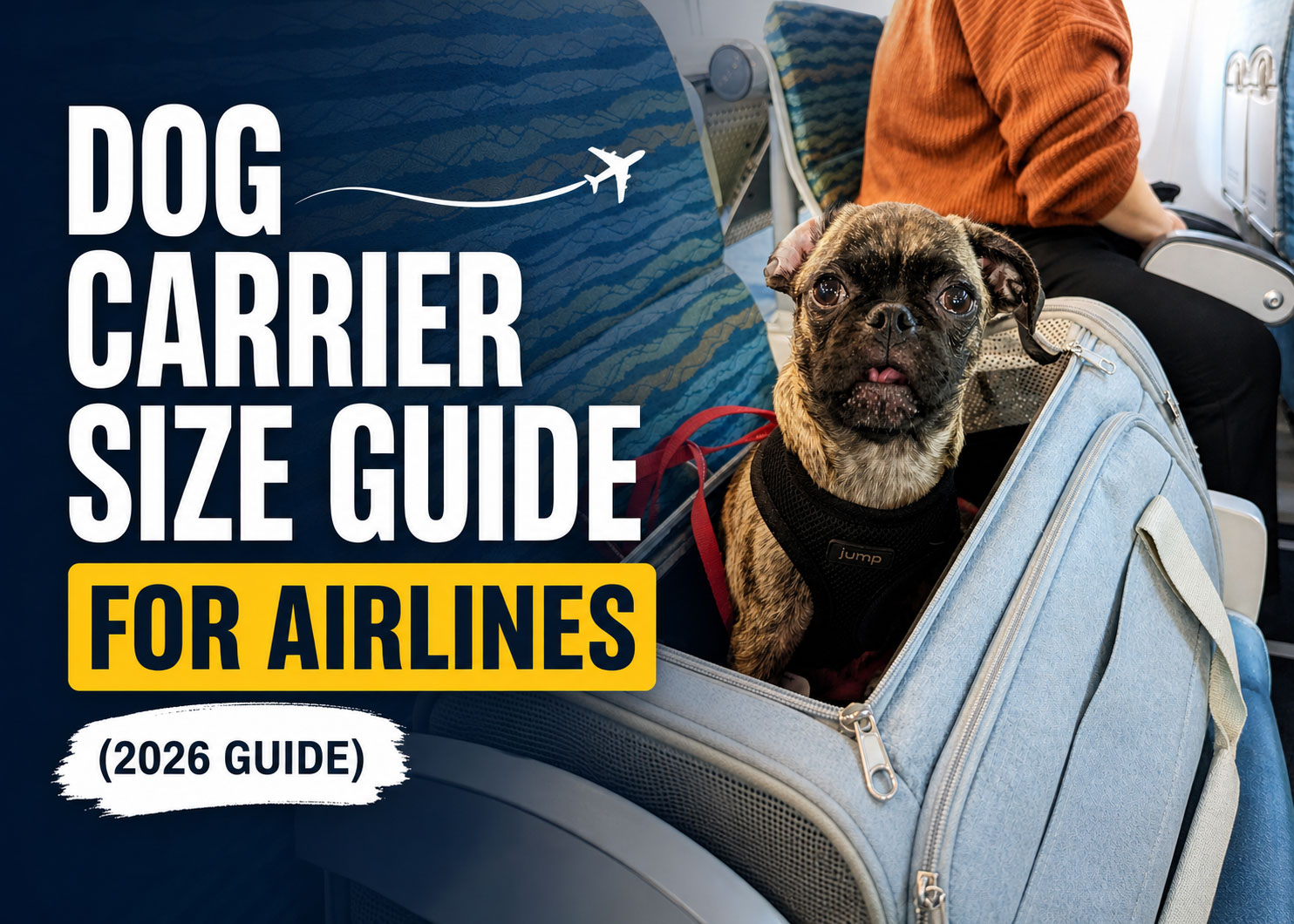
When it comes to flying with a dog, choosing the right carrier size is one of the most important decisions you will make.
It sounds simple until you start comparing airline policies. One airline lists maximum carrier dimensions in inches, another gives slightly different measurements, and a third may say the carrier simply needs to fit under the seat in front of you.
On top of that, your dog still has to fit comfortably inside the carrier, which is where many people get caught off guard.
The goal is not just to buy a carrier that matches an airline’s size chart. The real goal is to choose a carrier that fits your dog, fits under the airplane seat, and does not create problems at check-in.
I’ve flown with Beckham enough to know that airline pet policies are only a part of the equation. What actually happens at the airport will depend on the airline, the aircraft, the gate agent, the carrier, and most importantly how comfortable your dog looks inside it. This guide will walk you through what dog carrier size airlines usually allow, how to measure your dog properly, why soft-sided carriers are the better choice, and what to watch for before booking your flight.
What dog carrier size do airlines allow?
Most airlines require in-cabin dog carriers to fit under the seat in front of you. This is the main rule everything else comes back to. In general, airline-approved dog carriers are usually somewhere around 16 to 18 inches long, 10 to 12 inches wide, and 8 to 11 inches high. These numbers vary by airline, aircraft, and seat layout, so you should always check the exact airline policy before booking.
The tricky part is that carrier dimensions are only one piece of the requirement. Airlines also usually state that your dog must be able to stand, turn around, and lie down comfortably inside the carrier. So even if the carrier technically fits under the seat, your dog can still be denied if they look too cramped.
This is why choosing a carrier based only on weight limits is a mistake. A 15-pound long-bodied dog may need more room than a 15-pound compact dog. Airlines care about whether your dog fits safely and comfortably, not just what the scale says.
If your dog is close to the size limit for cabin travel, it is worth reading this comparison of cabin vs cargo travel
before you commit to a flight. Sometimes the question is not just “Will the carrier fit?” but “Is cabin travel actually realistic for this dog?”
Airline carrier size rules are not all the same
One of the most frustrating parts of flying with a dog is that every airline has its own pet carrier rules. Some airlines will give you exact maximum dimensions. Others provide more flexible guidance, especially when it comes to soft-sided carriers. Some are strict at check-in, while others focus more on whether the carrier fits under the seat and your dog is comfortable.
This is why a carrier approved on one airline may not be approved on another. Even if the difference is just an inch or two, it can matter. It also matters if you are flying domestically or internationally. International flights often involve stricter check-in procedures, more documentation, and more review of your dog, carrier, and paperwork by airline staff.
Before booking, check the airline’s current pet policy and confirm the carrier size requirements directly. If you are comparing airlines, this guide to the best airlines for dogs in 2026 can help you choose an airline that is generally more practical for pet travel.
Why the under-seat space matters most
The reason airlines limit dog carrier size is simple: the carrier has to fit under the seat in front of you.
Your dog’s carrier counts as your pet’s travel space during the flight. It cannot sit on your lap, block the aisle, or take up extra room. During taxi, takeoff, and landing, it usually needs to stay fully under the seat.
This is where real-world travel can get annoying. Under-seat space is not identical on every aircraft. A carrier that fits easily on one plane may feel much tighter on another. Even within the same airline, different aircraft can have different seat designs.
Bulkhead seats are usually a problem because there is often no under-seat storage in front of you. Exit rows are generally not allowed for passengers traveling with pets. Some premium cabin seats may also have limited under-seat space depending on the aircraft layout.
That is why I recommend choosing a soft-sided carrier that gives you a little flexibility. You do not want to buy the absolute largest carrier allowed and then discover that it barely fits on your specific plane. A slightly smaller, flexible carrier is easier to travel with than one that maxes out the published dimensions.
Soft-sided vs hard-sided carriers
If you are traveling in the cabin with your dog, a soft-sided carrier is usually the better choice. In some situations a hard-sided carrier can work, but they are less forgiving. If the carrier is even slightly too tall, it may not fit under the seat. It also cannot compress or adjust to the space in front of you.
Soft-sided carriers are more practical because they have a bit of give. They can usually slide under the seat more easily, and airline staff are often more comfortable approving them as long as your dog has enough room inside. That does not mean the carrier should collapse onto your dog. A good airline dog carrier should still have structure, ventilation, secure zippers, and enough space for your dog to rest comfortably.
The best carrier is not necessarily the biggest one. It is the one that balances airline size rules with your dog’s comfort.
How to measure your dog for an airline carrier
Before you buy a carrier, measure your dog properly.
Start with height. Measure from the floor to the top of your dog’s head while they are standing naturally. If your dog has upright ears, some airlines may expect the ears to fit comfortably too. Next, measure length. Measure from the tip of the nose to the base of the tail, not the end of the tail. This gives you a realistic idea of how much room your dog needs to lie down and turn around.
Compare those measurements to the internal dimensions of the carrier. This is important because exterior dimensions can be misleading. A carrier may be 18 inches long on the outside but offer less usable space inside because of padding, structure, pockets, or rounded corners.
Your dog should be able to stand without pressing hard into the top of the carrier. They should be able to turn around without struggling. They should also be able to lie down in a natural position.
If your dog looks uncomfortable in the carrier at home, the airport will not make it better. Travel adds noise, movement, waiting, security, boarding, and long periods in one place. A carrier that feels “just okay” during a quick test can become a real problem on travel day.
Weight limits matter, but size matters more
Many airlines list a maximum weight for pets in the cabin, but size is often the more important factor.
Some airlines do not have a strict dog weight limit at all. Instead, they focus on whether the dog fits safely inside the carrier and whether the carrier fits under the seat. Other airlines may list a combined weight limit for the dog and carrier together.
This is why two dogs with the same weight can have completely different travel outcomes. A compact dog may fit comfortably in an airline carrier, while a longer or taller dog of the same weight may not. Do not use weight as your only deciding factor. It can help you narrow things down, but your dog’s body shape and comfort inside the carrier matter more.
If your dog cannot comfortably fit in an in-cabin carrier, you may need to consider other options. This is where it helps to understand the full process of how to fly with a dog before booking.
What actually happens at the airport
In theory, airline carrier rules are straightforward. In real life, enforcement can vary.
At check-in, airline staff may ask to see your dog inside the carrier. They may check whether your dog can move around. They may also visually inspect the carrier to make sure it does not look oversized. Some agents are very strict. Others are more practical, especially if the carrier is soft-sided and your dog appears calm and comfortable.
This is one of the reasons why I always recommend you test the carrier before your flight. Don’t wait until travel day. Let your dog try out the carrier at home, in the car, and then in busier environments. The more “normal” the carrier feels to your dog, the easier the travel process will be.
A dog that is calm inside a properly sized carrier is much less likely to attract concern. A dog that is barking, pushing at the sides, or clearly uncomfortable may draw more attention. Even if the carrier technically meets the size rules.
Should you buy the largest carrier allowed?
It is tempting to buy the largest carrier the airline allows, but that is not always the best strategy.
A larger carrier gives your dog more room, but you risk the carrier will be difficult to fit under the seat. This is especially true on smaller aircraft or flights with tighter seat layouts. The better approach is to find the smallest carrier your dog can comfortably use while still staying safely within airline limits.
For small dogs, this balance is usually manageable. For dogs near the upper edge of in-cabin size, it becomes more complicated. Measure carefully, check the airline policy, and consider calling the airline before booking.
What dog carrier should you use for airline travel?
For most people flying with a small dog, I would look for a soft-sided airline carrier with good ventilation, secure zippers, a sturdy base, and enough flexibility to fit under the seat. The carrier should feel comfortable enough for your dog to spend several hours in it, but not so oversized that it creates problems during boarding or under-seat storage.
I personally prefer soft-sided carriers because they are easier to manage in real travel situations. They fit better in tight spaces, they are easier to carry through the airport, and they usually create fewer issues at check-in.
Common dog carrier size mistakes
One of the most common mistakes people make is buying a carrier that says “airline approved” and not checking the dimensions. “Airline approved” is not a universal certification. It usually just means the carrier is designed to meet common airline requirements. You still need to compare it against your specific airline’s pet policy.
Another mistake is forgetting that your dog needs to fit comfortably inside. Some people focus so much on under-seat dimensions that they forget the carrier also has to work for the dog.
I also would not recommend buying a carrier at the last minute. Your dog needs time to get used to it. A carrier should feel familiar before travel day, not like a new stressful object introduced right before a flight.
It is also important to avoid booking the wrong seat. Bulkhead and exit row seats are usually not pet-friendly because there is no usable under-seat space or because pets are not allowed there for safety reasons.
The final mistake is assuming that because one flight went smoothly, every future flight will be the same. Different airlines, aircraft, routes, and check-in agents can create different experiences.
Final thoughts
When it comes to dog carrier size requirements for airlines, it’s not just about the numbers. It’s about whether your dog can travel safely, comfortably, and without causing problems at the airport. The carrier needs to fit under the seat. Your dog needs to fit inside the carrier. And you need to feel confident that the setup will work in a real airport environment, not just in a product description online.
For most small dogs, a well-made soft-sided carrier is the best option. It gives you more flexibility, makes under-seat storage easier, and usually creates fewer issues with airline staff. Before you fly, measure your dog, check your airline’s current policy, test the carrier at home, and avoid pushing the size limits too closely.
Getting the carrier right makes the rest of the trip that much easier.
Frequently asked questions
What size dog carrier is allowed on airplanes?
Most airlines allow in-cabin dog carriers around 16 to 18 inches long, 10 to 12 inches wide, and 8 to 11 inches high, but exact limits vary by airline. The carrier must fit under the seat in front of you, and your dog must be able to stand, turn around, and lie down comfortably inside.
Can a dog carrier be slightly bigger than airline limits?
A soft-sided carrier may have a little flexibility if it can compress enough to fit under the seat, but this is never guaranteed. If the carrier looks too large or your dog appears cramped, airline staff can deny boarding.
Does my dog have to stay in the carrier the entire flight?
Yes, in most cases your dog needs to remain inside the carrier for the duration of the flight. Airlines usually require the carrier to stay under the seat during taxi, takeoff, and landing, and many require pets to remain inside throughout the entire flight.
What happens if my dog carrier is too big?
If your dog carrier is too big, the airline may deny boarding, require you to change flights, or tell you that your dog cannot travel in the cabin. This is why it is important to check the airline’s current pet policy and test the carrier before travel day.